Educational resource
Understanding the CMS Substance Access Beneficiary Engagement Incentive (BEI)
A guide for providers, patients, and healthcare organizations
Supporting implementation through standardized clinical protocols, patient monitoring, and outcomes reporting. The BEI is optional and available only to approved participants in ACO REACH, the Enhancing Oncology Model (EOM), and later the LEAD Innovation Center model.
- 0
- Metrics tracked weekly
- 0
- Success score components
- 0.0%
- Max Δ9-THC

Section 1
How the BEI works
From CMS model participation through quarterly reporting, each step stays under clinician oversight.
- 1
CMS Innovation Center
Defines the optional BEI and its requirements.
- 2
Approved ACO REACH / EOM participant
Submits an implementation plan and receives CMS approval.
- 3
Physician consultation
Shared decision-making with the treating clinician.
- 4
Patient eligibility review
Organization applies its eligibility process.
- 5
Eligible hemp product furnished
Procured and paid for by the participating organization.
- 6
Clinical monitoring
Medication review, follow-up, and documentation.
- 7
Patient-reported outcomes
Structured symptom and function check-ins.
- 8
Quarterly reporting
Per the organization's participation agreement.
Section 2
Who can participate?
Eligibility sits with the model participant and the treating clinician — not with a product supplier.
Providers
- ACO REACH participants
- Enhancing Oncology Model participants
- LEAD Innovation Center participants (2027+)
- Physician oversight required
- CMS-approved implementation plan required
- Quarterly reporting required
Patients
- Medicare beneficiary aligned with a participating organization
- Age 18+
- Physician determines CBD is appropriate
- Shared decision-making completed
- Meets the program's eligibility requirements
Additional eligibility criteria and exclusions are defined by CMS and the applicable participation agreements.
Blue Key
- Clinical CBD formulation
- Provider education
- Outcomes platform
- Patient monitoring
- COA verification
- Clinical reporting
Section 3
Eligible product requirements
Core CMS requirements for BEI participation, as defined by the Centers for Medicare & Medicaid Services.
Hemp-derived
- ≤ 0.3% Delta-9 THC
Oral administration
- No inhaled products
Third-party tested
- Potency
- Heavy metals
- Pesticides
- Microbial safety
Clinical documentation
- Provider oversight
- Medication review
- Shared decision-making
- Follow-up planning
Section 4
Provider workflow
Seven steps from enrollment to quarterly reporting, all inside one system of record.
- 1
Enroll patient
De-identified patient code, site, and care team.
- 2
Review eligibility
Model alignment and organizational criteria.
- 3
Shared decision-making
Documented consultation and consent.
- 4
Clinical CBD protocol
Batch-specific dosing instructions.
- 5
Weekly outcomes
Pain, sleep, anxiety, function, QoL, adherence.
- 6
Dashboard
Trends, alerts, and clinical success scores.
- 7
Quarterly reporting
Exportable, audit-ready summaries.
Section 5
Patient journey
What participation looks like for a beneficiary, start to follow-up.
- 1
Diagnosis
Care continues with the treating oncology team.
- 2
Discuss CBD with your physician
Shared decision-making, risks, benefits.
- 3
Receive product
Furnished by the participating organization.
- 4
Weekly check-ins
Two minutes on any phone or computer.
- 5
Symptom trends
See your own progress over time.
- 6
Provider follow-up
Your clinician reviews and adjusts the plan.
Two minutes a week
Patients complete a short check-in on pain, sleep, anxiety, daily function, quality of life, adherence, and medication changes. Reminders arrive by email on the schedule the care team selected, and every response flows straight to the provider dashboard.
- No app to install
- De-identified patient codes
- Batch and COA always one tap away
- Personal trend charts
Section 6
What gets tracked?
Six validated domains, captured longitudinally and rolled into a clinical success score (pain 30%, sleep 20%, anxiety 20%, adherence 15%, medication reduction 15%).
Pain
Lower is better0–10 numeric rating
Illustrative 7-week trend
Sleep
Higher is better1–5 sleep quality
Illustrative 7-week trend
Anxiety
Lower is better0–10 severity
Illustrative 7-week trend
Daily function
Higher is better1–5 activity level
Illustrative 7-week trend
Medication changes
Lower is betterOpioid / adjunct reduction
Illustrative 7-week trend
Quality of life
Higher is better1–5 global QoL
Illustrative 7-week trend
Section 7
Blue Key Clinical Outcomes Management Platform
One system of record for enrollment, monitoring, batch traceability, and reporting.
Active patients
128
Pain reduction
↓ 38%
Adherence
91%
Success score
72/100
Provider dashboard
Patient portal
Outcome analytics
Clinical reports
Batch tracking
COA verification
Patient-reported outcomes
Exportable reports
Section 8
Why outcomes matter
The platform is designed to support standardized documentation, patient monitoring, and quality improvement. Participating organizations remain responsible for all CMS reporting required under their participation agreements.
Step 1
Patient
Improved care
Step 2
Provider
Better documentation
Step 3
Organization
Population health
Step 4
CMS
Model evaluation
Section 9
Blue Key Clinical CBD
One component of a broader clinical solution — fully traceable from batch to bedside.
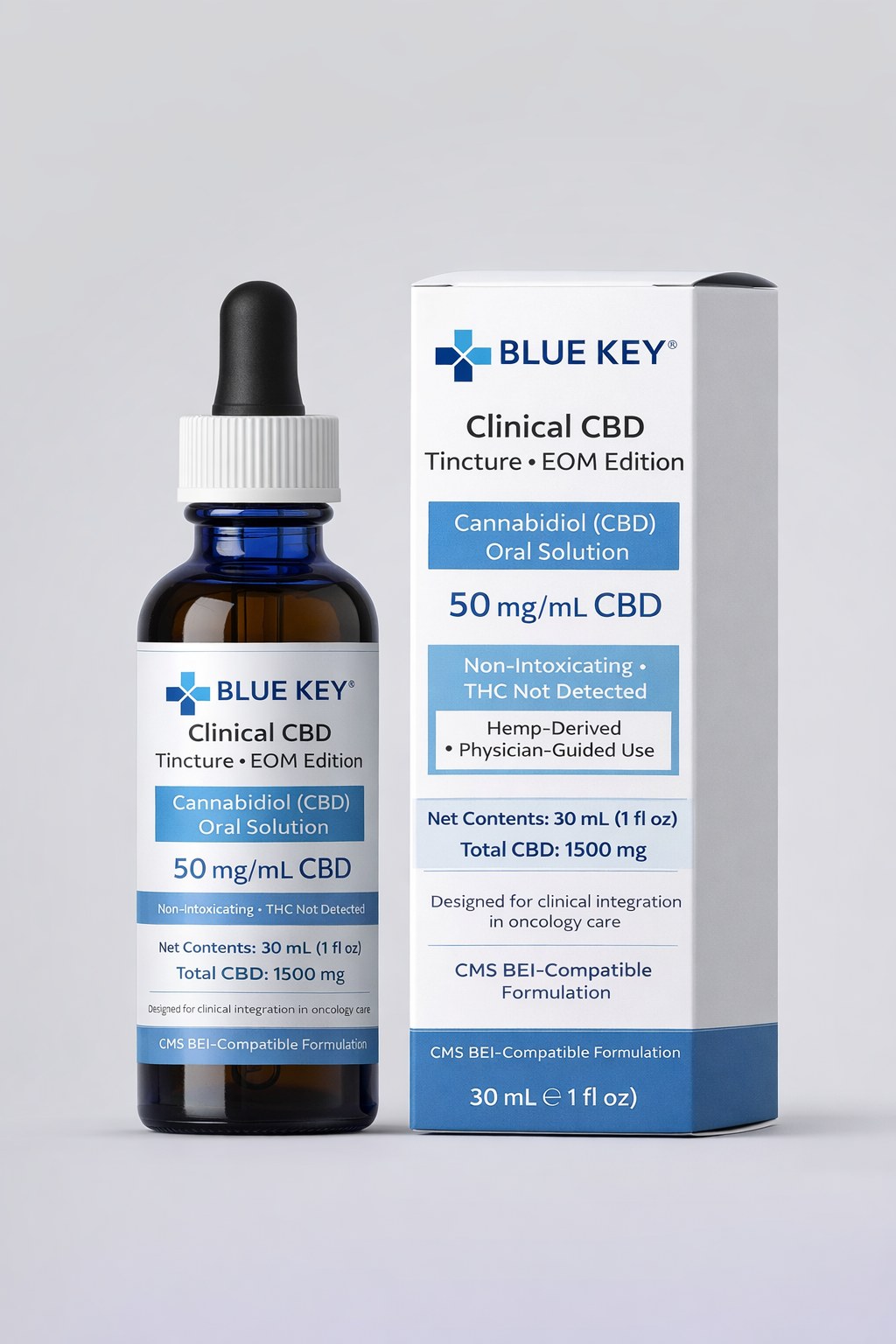
50 mg/mL
Oral tincture, calibrated dropper
THC not detected
Current tested batch
COA verified
Potency, metals, pesticides, microbials
QR code
Scan for COA and dosing instructions
Batch tracking
Every patient record links to its batch
Documentation
Dosing guidance stored with the record
Section 10
Frequently asked questions
Program details reflect guidance from the Centers for Medicare & Medicaid Services. Always confirm requirements against your organization's participation agreement.
Ready to learn more?
Blue Key supports approved model participants with clinical protocols, monitoring, and outcomes reporting. Implementation and CMS obligations remain with the participating organization.